How-to: Paint Furniture with Asian Paints

September 15, 2010

In continuation of yesterday’s post, I’ll describe the process that you can apply to paint any wooden furniture. So, if you’re game for some hard work, let’s get started.

Preparation:

1. Identify the piece of furniture you want to paint. And, be convinced why you want to paint. Some pieces of furniture look best in their natural form. For instance, you don’t want a yellow paint over a beautifully carved teak wood cabinet, right?

2. Come up with a color scheme. Do a bit of research and use your design gut to finalize colors. To add zing to bare white walls, brightly painted furniture is a good idea. But if you have a thematic wall, already, adding more color wouldn’t bring the object to focus. In this case, a neutral color would work well.

Things you’ll need:

Now that we’ve settled on the colors, let’s go do some shopping.  I used the Royale Emulsion (yea, the Saif Ali Khan series) range from Asian Paints for this project. Not that I’m a big fan of Saif, but since Asian Paints were the pioneer in the Indian market to have introduced odorless, water-based enamel.

1. Sand Paper - 6 to 7 sheets. You’ll need many sheets for the sanding process. Don’t go by what’s written on the paint tin. The highest grade you can get for sanding wooden furniture is 120. Keep a few sheets extra as it is costs only Rs. 4 per sheet and you don’t want to be running like me to the hardware shop every other day.

2.Dirty clothes.

3. Newspapers

4. Old paint tin for mixing colors.

5. Two brushes. A wide one and a narrow one. Don’t buy a very wide brush for furniture.

6. 1 liter of Royal Enamel (water-thinnable) - Mango Mood (Orange)

7. 1 liter of Royal Enamel (water-thinnable) - Red.

8. Primer from Asian Paints (again water thinnable).

9. Safety glasses

The total cost for these items was Rs.950. Paint is the most expensive part in this. If you choose a medium range that is solvent-thinnable, then the cost of the project will come down by about Rs.200. I personally find using thinner as a solvent very cumbersome. Cleaning the brushes and the floor is a lot more hard work. And you can’t afford to be negligent as with a water-based one.

Steps for Painting:

1. Spread newspapers on the floor. Wear old clothes. Put of your safety glasses.

2. Sand the surface well using emery sheets. If you are dust-allergic, then be sure to cover your face, or hire someone for an hour or two to sand.This is the most important step and every nook and corner should be sanded well. If not, when you start painting, you’ll find the paint flaking off.

3. Once sanding is done, shake the primer tin and open it. Pour a small quantity of primer in the empty paint bucket. Add little water to this so that it is neither too thick nor too flowy.

3. Start applying the primer using a brush. If you’ve never painted before, this is a good time to get used to feeling the brush in your hands. The strokes don’t matter much now. Ensure the entire surface is covered with primer.

4. Let it dry for 3-4 hours.

5. Sand the primed surface again.

6. Apply one more coat of primer. If you had mixed more primer the first time, take care to cover the leftover until next usage.

7. Let the second coat dry for 3-4 hours. Sand the surface again.

8. Empty the primer bucket. Wash it clean.

9. Mix a little quantity of orange paint in water in the empty paint bucket. Paint the desired area. Don’t take too much paint on the brush. Apply evenly for a smooth finish.

10. Let it dry after the first coat for 6 hours.

11. Follow up with a second coat and if needed, third coat. The cot took 3 coats, something typical of Asian Paints.

12. Once you’re done with orange, move over to red, or whatever color you choose.

It took me about a week and a total of 6 hours to finish painting as I did it in parts. There were times when my husband and my son helped me with a stroke or two. When it started getting messy, I gave them some assorted piece of furniture to try their skills on :)

Painting is still not viewed as a DIY activity in India. So, yes, you may get a few raised eyebrows every time you go  shopping.  A few months back, when I asked how much water I would need to mix for primer, the vendor replied, “Don’t worry ma’am. The painter will know.” The I’m-the-painter response from me caught him unawares.

I had a lot of fun painting this bed. I hope you’ll be inspired to paint some thing in your home as well. Don’t forget to share pictures when you do.

DIY Inspiration: Painted Bed

September 14, 2010

One evening last month, while searching for a sofa for our living room, I happened to go to the @ home store in Marathahalli with my son. When we moved from the Living section to the Bedroom section, his eyes caught a colorful red-and-orange colored bunker with a nice set of wheels and ladder. To be honest, even I loved it. He insisted on getting it home, and in the heat of the moment, I promised to paint his bed in the same color scheme. He immediately agreed and we got home. The episode was forgotten.

A week passed and I made no effort on keeping my promise (quite unlike me). He gently reminded me one afternoon after returning from school that his bed still had no wheels or, yellow and red color. It was time to get acting. I made a mental note to get the required colors before he got home the next day. And, so began the most ambitious DIY project of my life…

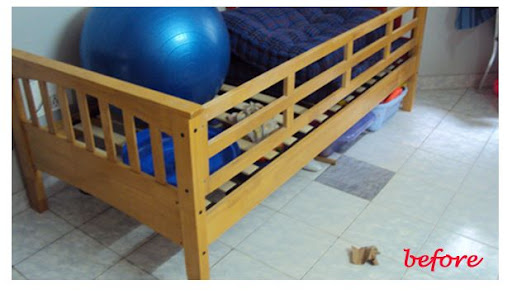
It’s  rubber-wood bunker with rails on either side.  It is over a  year old and I had picked it up from Oak n Oak for Rs.16,000.  This is the upper portion of the bunker before I started in all its ruggedness…

Without any doubt, the most laborious part of painting. Sanding followed by priming. I learned the hard way that if you don’t get this right, your project is doomed no matter how hard you try.

Seeing the yellows and reds after I painted the first part gave me a huge thrill of having achieved some thing. The finish was silky smooth. It gave me the confidence to paint the rest.

And here, I’m done. The bed rests in its almost final setting.

The lower part of the bunker is still waiting to be painted. I hope to get back to it in early December. Maybe, I will also add some fun elements to the headboard like a wheel or Winnie the Pooh.

Cost of the project: Rs.1200
Time spent : 6 hours
The look on my son’s face : priceless.

I’ll post a step-by-step procedure tomorrow on how to paint any furniture in the color you like.

Hand-painted Turquoise Pottery

August 10, 2010

Good afternoon everybody! With the rains making a guest appearance only on Monday, I hope you all had a wonderful weekend. It has been a busy weekend at “dress your home”, in literal sense. I can’t remember the last time we were involved as a family in a rigorous DIY activity. Friday saw me returning home with cans of fresh, bright paint. By Saturday afternoon,  we were in our muddy clothes holed up in the kid’s bedroom with newspapers sprawled on the floor and paint brushes in the hand. The job is still far from done, so you will have to wait for pictures :) But, I promise it will be a long post full of pictures with a step-by-step guide (about what? keep guessing!)

Before I started on the BIG project, I hand painted a terracotta pot on Thursday in one of my favorite colors - Turquoise.  I love Turquoise because its bright, cheerful and is a head-turner. Don’t you agree? ever since I painted one of the pots in this electric color, it’s taken away the attention from my other pots. It’s picture time now.

This was how it was before I started.

Earthen pot

Earthen pot

After a night of immersing the pot in a bucket of water, it was ready to be painted the next morning. Earthenware absorb less color when left in water for a few hours.

Painted in Turquoise

Painted in Turquoise

The pot has a metallic shine to it as I’ve used pearl acrylic colors.

Read the rest of this entry…

Ideas for Painting Old Furniture

August 5, 2010

Do we have any diligent readers (read: obsessively checking Google Reader for new posts) of Apartment Therapy here? If yes, you would know that a good chunk of posts are about restoring or transforming old furniture through painting and replacing the hardware. Images of antique, worn wooden cabinet/dresser/table painted into white or turquoise blue are swimming in my head now.

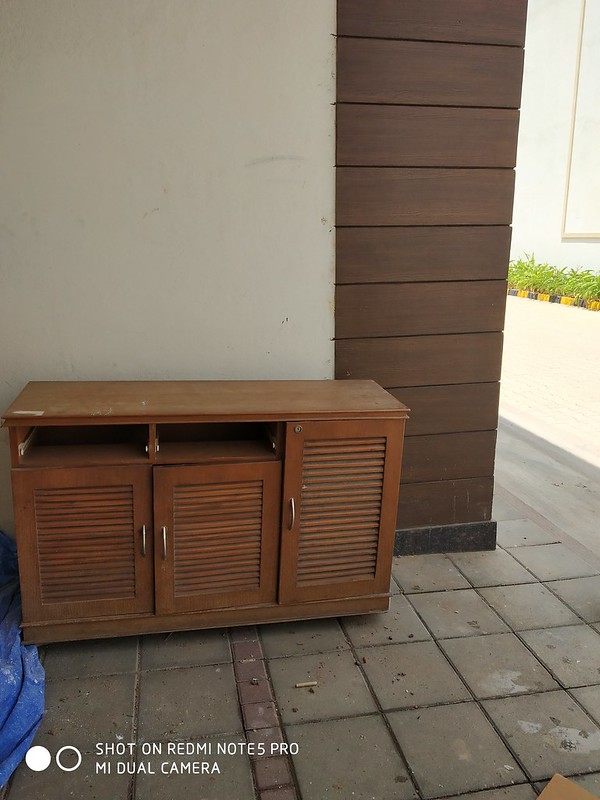
For me, when it comes to home renovation,  there is nothing more satisfying than giving a face lift to old furniture. To discard the old and buy new stuff is easy work, don’t you think? There are a few odd pieces of furniture in every house such as a chair, cabinet, side table that look aged.  A polish or a new coat of paint will do them good. I want to get started off with a old cabinet first.  It’s about six years old and in good working condition. It has lost its sheen so I’m toying with the idea of retaining its natural finish with a coat of lacquer or doing something radical like painting it in a bold color combination of white-lime green or white-turquoise blue.

Wooden cabinet

Wooden cabinet

I’ve been looking around for ideas and there are quite a few interesting ones that I would like to share.

For a ethnic, Indian theme, bright colors such as fuchsia, red or violet are a good choice to complete the look. However, if you have a monochromatic or minimalistic theme, a single of furniture in a dashing color will look out of place. In the picture below, for instance, Kishani Perera has used a good mix of ethnic elements like hand-carved open book case, painted trunk as center table, cradle-styled chairs, and printed cushions. All the accessories blend well with the bright orange colored walls.

Trunk in red

Trunk in red

Read the rest of this entry…

Gardening: Decorating Ideas for Planters

May 20, 2010

Before we get to the wooden collections from Jin Kuramoto Studio, let me tell you how I got there.  I have two identical terra cotta pots with an interesting shape waiting to be painted and planted. I got it on my trip to Mahabalipuram; so they’ve been sitting in my balcony for over a month. I can’t settle on a design/color for the pots, and am constantly looking for fresh ideas. While scouting for modern patterns, I discovered materialicious.  According to the folks who run the site, “materialicious™ (”shelter, materials and objects”) is a user-submitted visual curation site featuring modern architecture and design, craftsmanship, materials and products.” True to every word. You can’t get your eyes off the page once you start browsing, and before you realise you’ve spent enough time wasting looking at the stunners.

Now, materialicious is what led me to  Jin Kuramoto Studio. The wooden tea sets and mirrors in striking, contrasting, and complementary colors leaves a lasting impression. It’s easier to reproduce the same effect with planters. I need not delve further into the effect it would bring into one’s garden.  The traditional wooden tea sets in subdued earthen colors with simple stripes is unique too.

Striped planters

Striped planters

Consider growing a herb garden in the smaller ones by placing them on your kitchen windowsill.

For dark, bright colored planters

For dark, bright colored planters

Black absorbs heat and can be harmful for the plants during the summer months. Go for a little lighter shade while retaining the effect.

White rules

White rules

When you’ve run out of ideas, a easy fallback option is a white planter. - you can never go wrong with this one. Give it a little texture, group a couple of them in different shapes in a corner, and you have a winner.

While we’re on the topic of painting planters, I feel compelled to share how discarded cups were transformed into eye-catching reusable pieces with a little design on them. And, if those designs happen to be characters from Alice in Wonderland, can one resist?

Alice in Wonderland ceramic cups

Alice in Wonderland ceramic cups

Images:

1.2.3. - Jin Kuramoto

4 - Dagens Design

No Entryway? How to Create a Foyer

November 2, 2009

Your foyer is an indication of what to expect inside the home. Color or muted interiors, organized or cluttered,  storage space, accessories etc. A organized, tastefully decorated foyer generally leads to a equally well-maintained home. If the entryway is disheveled, then your guess is as good as mine as to how rest of the house will be.

I’ve always liked having a foyer so that the front door doesn’t open directly into the living room.  But, unfortunately, the apartments I’ve lived in have never had one.  So, I’m always scrambling for a space to hang coats, helmets, keys, and place the shoe rack. Imagine having a house plant or a vase with fresh flowers on top of the shoe rack - what a welcoming feeling every time one steps inside the house.

Several apartments I’ve seen in metros do not have a foyer. And surprisingly, all but very few apartments in tier-II and tier-III cities have one. So, why do you need one and what comprises the space? I need it for two reasons - privacy and storage.

Read the rest of this entry…

Three Ways to Style a Door

July 31, 2009

Who says your interior doors have to be neutral in color? Tired of the white/ivory color doors? Bright colors need not be restricted to walls, curtains or furniture. Go bold with these three ideas and style your door differently…

Bright paint can make so much of a difference…

Colorful Door

Colorful Door

Read the rest of this entry…

How to : Recycle Old Coasters

July 27, 2009

I had a set of 6 wooden coasters that were nearly 5 years old. Dull, faded, and ready to be discarded. But the coasters/place mats are the sturdy kind that I didn’t have the heart to just junk it. So over the weekend I transformed a pair (to begin with) into these bright, colorful coasters.

Colorful Coasters

Colorful Coasters

How to paint:

The steps are similar to how we painted the cane furniture: sanding, priming, painting followed by a coat of varnish. The only difference is I used acrylic paint for this project.

Coaster Painting Steps

Coaster Painting Steps

Signature Wall from Asian Paints

July 16, 2009

Asian Paints recently opened their Signature Store in Mumbai. NDTV Hot property featured the colorful store as part of the show’s last segment. The design of the store, patterns, texture, and an impressive product line-up left me awestruck. Though my experience with Asian Paints Home Solutions (for painting) has not been great in the past, I logged on to the site to see what they have to offer this time. I must say, it looks neat.

The entire site is worth browsing. Yea, add it to your list of time-wasters :) Going by what they claim, it does sound like kids will finally have the freedom to get creative on the walls (or do they call scribbling?).

Get Creative on the walls. Moms can scream no more!

Get Creative on the walls. Moms can scream no more!

Wall Decor from Asian Paints

Wall Decor from Asian Paints

The colourwash effect under special effects, in particular, looks cool.

How To: Paint Terracotta planters

July 15, 2009

Terra Cotta planters are common along the road side in most cities across India. They come in various shapes, sizes, and forms including animals and gods.

I bought a pair of planters for Rs. 80 a few months ago, filled them with potting soil, and planted ivy (money) plants. A few weeks ago, itching to do something, I turned one of the planters into a decorative vase.

Terra Cotta Planter

Terra Cotta Planter

What you’ll need:

1. Brush

2. Acrylic Paint - black and white

3. Palette or a cup.

4.  Fevicol

5. Water

6. Varnish

Read the rest of this entry…

Related Posts Plugin for WordPress, Blogger...